 Add to Chrome
 Add to Firefox
 Add to Edge
Qwen-Image-Bench: From Generation to Creation in Text-to-Image Evaluation
May 27, 2026
Text-to-Image generation has evolved from basic image synthesis into a frequently used core capability in professional creative workflows, where simple text-image alignment can no longer satisfy users' pressing demands for faithful real-world reconstruction and genuine creative expression. Existing benchmarks, however, remain anchored in these foundational criteria and do not yet capture the nuanced capabilities that matter in authentic artistic practice, making it difficult to reliably distinguish state-of-the-art T2I models. To address the gap, we introduce Qwen-Image-Bench, a creator-centric benchmark co-designed with professional artists and grounded in real-world creation scenarios. Qwen-Image-Bench enriches conventional evaluation with two application-driven dimensions: Real-world Fidelity and Creative Generation. Drawing on the staged reasoning inherent in professional artistic workflows, we organize these five pillars into a top-down hierarchical taxonomy that further decomposes into 23 second-level sub-capabilities and 56 third-level verifiable rubrics. To ensure broad coverage, we curate 1000 stratified prompts with each prompt jointly exercising more than four fine-grained facets across multiple pillars. We train a unified judge model Q-Judger based on Qwen3.6-27B, supervised by 80 professional annotators from global art academies under blind labeling and triple-review protocols, that scores every image across all 56 verifiable facets, producing fine-grained, rubric-grounded, and fully attributable diagnostics rather than a single opaque score. Empirically, Qwen-Image-Bench reliably distinguishes leading T2I models, achieving the greatest separation on the two application-driven dimensions of Real-world Fidelity and Creative Generation where existing benchmarks provide little insight, while also providing a trustworthy optimization signal for production-level T2I development.

Qwen-Image-VAE-2.0 Technical Report
May 13, 2026We present Qwen-Image-VAE-2.0, a suite of high-compression Variational Autoencoders (VAEs) that achieve significant advances in both reconstruction fidelity and diffusability. To address the reconstruction bottlenecks of high compression, we adopt an improved architecture featuring Global Skip Connections (GSC) and expanded latent channels. Moreover, we scale training to billions of images and incorporate a synthetic rendering engine to improve performance in text-rich scenarios. To tackle the convergence challenges of high-dimensional latent space, we implement an enhanced semantic alignment strategy to make the latent space highly amenable to diffusion modeling. To optimize computational efficiency, we leverage an asymmetric and attention-free encoder-decoder backbone to minimize encoding overhead. We present a comprehensive evaluation of Qwen-Image-VAE-2.0 on public reconstruction benchmarks. To evaluate performance in text-rich scenarios, we propose OmniDoc-TokenBench, a new benchmark comprising a diverse collection of real-world documents coupled with specialized OCR-based evaluation metrics. Qwen-Image-VAE-2.0 achieves state-of-the-art reconstruction performance, demonstrating exceptional capabilities in both general domains and text-rich scenarios at high compression ratio. Furthermore, downstream DiT experiments reveal our models possess superior diffusability, significantly accelerating convergence compared to existing high-compression baselines. These establish Qwen-Image-VAE-2.0 as a leading model with high compression, superior reconstruction, and exceptional diffusability.
Qwen-Image-2.0 Technical Report
May 11, 2026We present Qwen-Image-2.0, an omni-capable image generation foundation model that unifies high-fidelity generation and precise image editing within a single framework. Despite recent progress, existing models still struggle with ultra-long text rendering, multilingual typography, high-resolution photorealism, robust instruction following, and efficient deployment, especially in text-rich and compositionally complex scenarios. Qwen-Image-2.0 addresses these challenges by coupling Qwen3-VL as the condition encoder with a Multimodal Diffusion Transformer for joint condition-target modeling, supported by large-scale data curation and a customized multi-stage training pipeline. This enables strong multimodal understanding while preserving flexible generation and editing capabilities. The model supports instructions of up to 1K tokens for generating text-rich content such as slides, posters, infographics, and comics, while significantly improving multilingual text fidelity and typography. It also enhances photorealistic generation with richer details, more realistic textures, and coherent lighting, and follows complex prompts more reliably across diverse styles. Extensive human evaluations show that Qwen-Image-2.0 substantially outperforms previous Qwen-Image models in both generation and editing, marking a step toward more general, reliable, and practical image generation foundation models.
Conflicts Make Large Reasoning Models Vulnerable to Attacks
Apr 10, 2026Large Reasoning Models (LRMs) have achieved remarkable performance across diverse domains, yet their decision-making under conflicting objectives remains insufficiently understood. This work investigates how LRMs respond to harmful queries when confronted with two categories of conflicts: internal conflicts that pit alignment values against each other and dilemmas, which impose mutually contradictory choices, including sacrificial, duress, agent-centered, and social forms. Using over 1,300 prompts across five benchmarks, we evaluate three representative LRMs - Llama-3.1-Nemotron-8B, QwQ-32B, and DeepSeek R1 - and find that conflicts significantly increase attack success rates, even under single-round non-narrative queries without sophisticated auto-attack techniques. Our findings reveal through layerwise and neuron-level analyses that safety-related and functional representations shift and overlap under conflict, interfering with safety-aligned behavior. This study highlights the need for deeper alignment strategies to ensure the robustness and trustworthiness of next-generation reasoning models. Our code is available at https://github.com/DataArcTech/ConflictHarm. Warning: This paper contains inappropriate, offensive and harmful content.
Qwen-Image-Layered: Towards Inherent Editability via Layer Decomposition
Dec 17, 2025Recent visual generative models often struggle with consistency during image editing due to the entangled nature of raster images, where all visual content is fused into a single canvas. In contrast, professional design tools employ layered representations, allowing isolated edits while preserving consistency. Motivated by this, we propose \textbf{Qwen-Image-Layered}, an end-to-end diffusion model that decomposes a single RGB image into multiple semantically disentangled RGBA layers, enabling \textbf{inherent editability}, where each RGBA layer can be independently manipulated without affecting other content. To support variable-length decomposition, we introduce three key components: (1) an RGBA-VAE to unify the latent representations of RGB and RGBA images; (2) a VLD-MMDiT (Variable Layers Decomposition MMDiT) architecture capable of decomposing a variable number of image layers; and (3) a Multi-stage Training strategy to adapt a pretrained image generation model into a multilayer image decomposer. Furthermore, to address the scarcity of high-quality multilayer training images, we build a pipeline to extract and annotate multilayer images from Photoshop documents (PSD). Experiments demonstrate that our method significantly surpasses existing approaches in decomposition quality and establishes a new paradigm for consistent image editing. Our code and models are released on \href{https://github.com/QwenLM/Qwen-Image-Layered}{https://github.com/QwenLM/Qwen-Image-Layered}
Step-Video-TI2V Technical Report: A State-of-the-Art Text-Driven Image-to-Video Generation Model
Mar 14, 2025We present Step-Video-TI2V, a state-of-the-art text-driven image-to-video generation model with 30B parameters, capable of generating videos up to 102 frames based on both text and image inputs. We build Step-Video-TI2V-Eval as a new benchmark for the text-driven image-to-video task and compare Step-Video-TI2V with open-source and commercial TI2V engines using this dataset. Experimental results demonstrate the state-of-the-art performance of Step-Video-TI2V in the image-to-video generation task. Both Step-Video-TI2V and Step-Video-TI2V-Eval are available at https://github.com/stepfun-ai/Step-Video-TI2V.
EG4D: Explicit Generation of 4D Object without Score Distillation
May 28, 2024In recent years, the increasing demand for dynamic 3D assets in design and gaming applications has given rise to powerful generative pipelines capable of synthesizing high-quality 4D objects. Previous methods generally rely on score distillation sampling (SDS) algorithm to infer the unseen views and motion of 4D objects, thus leading to unsatisfactory results with defects like over-saturation and Janus problem. Therefore, inspired by recent progress of video diffusion models, we propose to optimize a 4D representation by explicitly generating multi-view videos from one input image. However, it is far from trivial to handle practical challenges faced by such a pipeline, including dramatic temporal inconsistency, inter-frame geometry and texture diversity, and semantic defects brought by video generation results. To address these issues, we propose DG4D, a novel multi-stage framework that generates high-quality and consistent 4D assets without score distillation. Specifically, collaborative techniques and solutions are developed, including an attention injection strategy to synthesize temporal-consistent multi-view videos, a robust and efficient dynamic reconstruction method based on Gaussian Splatting, and a refinement stage with diffusion prior for semantic restoration. The qualitative results and user preference study demonstrate that our framework outperforms the baselines in generation quality by a considerable margin. Code will be released at \url{https://github.com/jasongzy/EG4D}.
Using Left and Right Brains Together: Towards Vision and Language Planning
Feb 16, 2024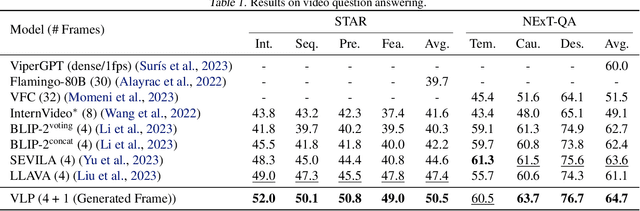
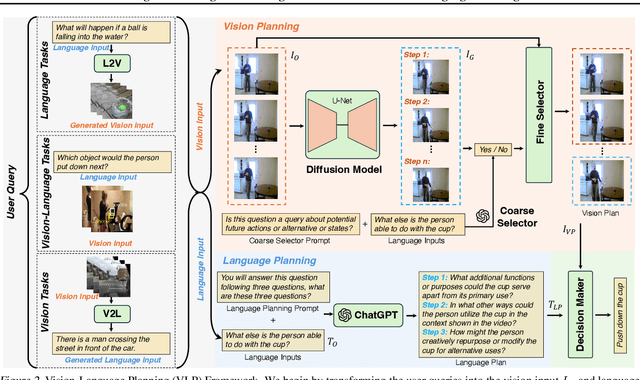
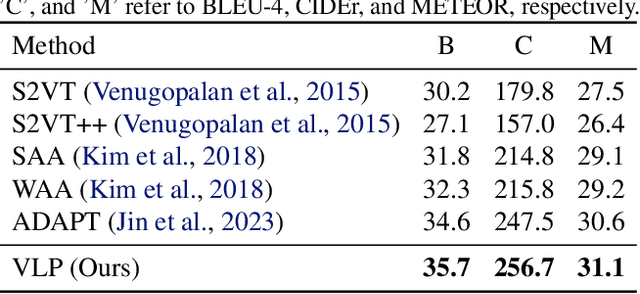
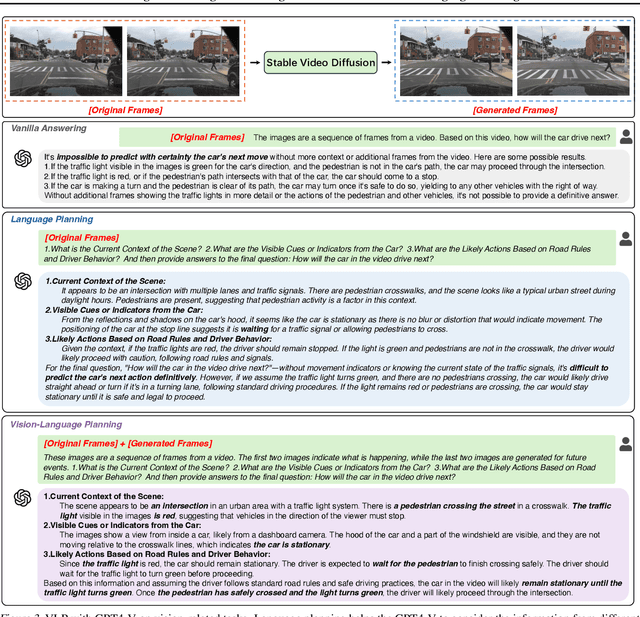
Large Language Models (LLMs) and Large Multi-modality Models (LMMs) have demonstrated remarkable decision masking capabilities on a variety of tasks. However, they inherently operate planning within the language space, lacking the vision and spatial imagination ability. In contrast, humans utilize both left and right hemispheres of the brain for language and visual planning during the thinking process. Therefore, we introduce a novel vision-language planning framework in this work to perform concurrent visual and language planning for tasks with inputs of any form. Our framework incorporates visual planning to capture intricate environmental details, while language planning enhances the logical coherence of the overall system. We evaluate the effectiveness of our framework across vision-language tasks, vision-only tasks, and language-only tasks. The results demonstrate the superior performance of our approach, indicating that the integration of visual and language planning yields better contextually aware task execution.
StrokeNUWA: Tokenizing Strokes for Vector Graphic Synthesis
Jan 30, 2024To leverage LLMs for visual synthesis, traditional methods convert raster image information into discrete grid tokens through specialized visual modules, while disrupting the model's ability to capture the true semantic representation of visual scenes. This paper posits that an alternative representation of images, vector graphics, can effectively surmount this limitation by enabling a more natural and semantically coherent segmentation of the image information. Thus, we introduce StrokeNUWA, a pioneering work exploring a better visual representation ''stroke tokens'' on vector graphics, which is inherently visual semantics rich, naturally compatible with LLMs, and highly compressed. Equipped with stroke tokens, StrokeNUWA can significantly surpass traditional LLM-based and optimization-based methods across various metrics in the vector graphic generation task. Besides, StrokeNUWA achieves up to a 94x speedup in inference over the speed of prior methods with an exceptional SVG code compression ratio of 6.9%.
ORES: Open-vocabulary Responsible Visual Synthesis
Aug 26, 2023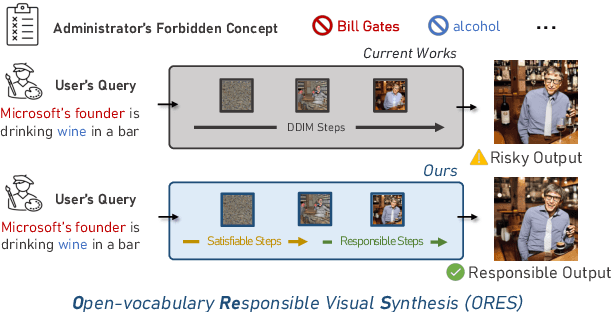

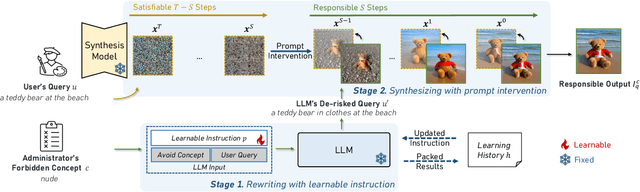

Avoiding synthesizing specific visual concepts is an essential challenge in responsible visual synthesis. However, the visual concept that needs to be avoided for responsible visual synthesis tends to be diverse, depending on the region, context, and usage scenarios. In this work, we formalize a new task, Open-vocabulary Responsible Visual Synthesis (ORES), where the synthesis model is able to avoid forbidden visual concepts while allowing users to input any desired content. To address this problem, we present a Two-stage Intervention (TIN) framework. By introducing 1) rewriting with learnable instruction through a large-scale language model (LLM) and 2) synthesizing with prompt intervention on a diffusion synthesis model, it can effectively synthesize images avoiding any concepts but following the user's query as much as possible. To evaluate on ORES, we provide a publicly available dataset, baseline models, and benchmark. Experimental results demonstrate the effectiveness of our method in reducing risks of image generation. Our work highlights the potential of LLMs in responsible visual synthesis. Our code and dataset is public available.